Combining infrared sauna with red light therapy offers a range of evidence-backed wellness benefits, but it’s crucial to approach these advanced therapies with a well-informed perspective. Both modalities are generally considered safe for most healthy adults, yet there are important factors, precautions, and contraindications that should guide responsible usage.
Hydration And Heat Sensitivity
Infrared heat efficiently raises core body temperature, which can lead to dehydration if fluid intake isn’t maintained. Users should drink water before, during, and after sessions. Those with low heat tolerance or a history of fainting should begin with shorter, lower-temperature exposures and gradually build up as their tolerance develops.
Medical Conditions
Individuals with cardiovascular disease, unstable blood pressure, or a history of heart conditions should consult a medical professional before using any kind of sauna or phototherapy. Infrared heat can increase heart rate and blood flow, which may pose risks for some cardiac patients. Similarly, those with implanted medical devices, such as pacemakers or metallic implants, should verify compatibility, as extreme heat or certain light wavelengths could interfere with these devices.
Pregnancy And Pediatric Use
Sauna use is generally discouraged for pregnant individuals due to the potential for overheating and dehydration, both of which may impact fetal health. Children and teenagers, whose bodies regulate temperature less efficiently, should also use extreme caution and consult a physician before engaging in regular sauna or light therapy sessions.
Photosensitivity And Medications
Red light therapy operates within a specific wavelength range, but some users may be sensitive to even these safe exposures. Certain medications, including antibiotics and retinoids, can increase photosensitivity and amplify reactions; it’s wise to consult a healthcare provider about potential side effects before starting red light therapy.
Skin Conditions
Those with active skin eruptions, severe eczema, or open wounds should avoid sauna and phototherapy until symptoms resolve. Likewise, people with a history of skin cancer or at high risk should seek medical advice on safe exposure limits.
By understanding these safety considerations and contraindications, users can maximize the restorative benefits of an infrared sauna with red light therapy while minimizing risk.
What To Look For In Wood, Heaters, And LEDs: How Medical Saunas Deliver On All Three
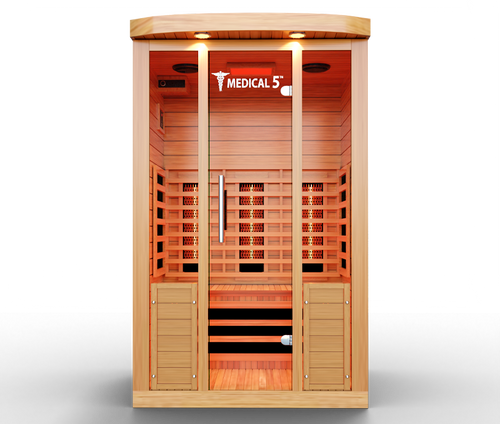
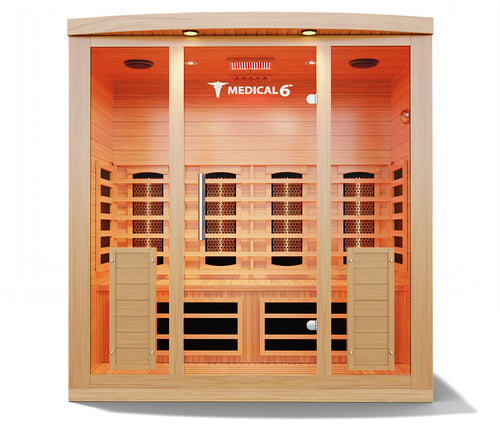
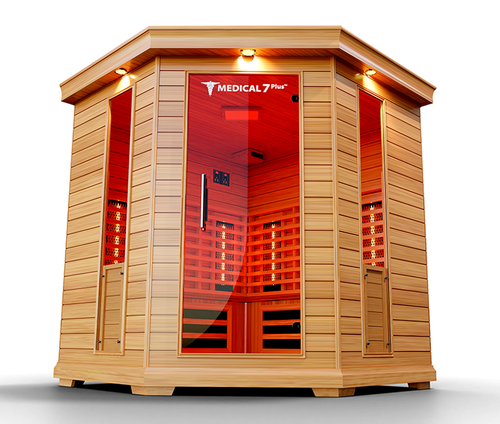
The foundation of any high-performing infrared sauna with red light therapy starts with its core components. Material quality directly affects therapeutic outcomes, air quality, and how long the unit performs at a medical-grade level. At Medical Saunas, these decisions are never afterthoughts.
Choosing Wood That Supports A Clean Sauna Environment
Quality starts with the wood. Dense, hypoallergenic natural hemlock delivers structural stability alongside strong insulation and airflow, distributing heat evenly throughout the cabin. Medical Saunas builds exclusively with untreated, sustainably harvested hemlock to minimize exposure to chemicals and allergens, a critical factor during repeated daily use. Over years of sessions, this commitment to clean materials has a direct impact on both air purity and the long-term integrity of the cabin.
The Role Of Full-Spectrum Infrared Heaters
The heating system drives both performance and health outcomes, which is why Medical Saunas' indoor infrared models are equipped with full-spectrum infrared heaters that deliver near, mid, and far infrared wavelengths, each reaching the body at different depths.
This range of penetration activates circulation, muscle recovery, and deep-tissue relaxation within a single session. The rapid internal heating system built into every Medical Saunas unit also allows precise control over temperature and duration, core variables for users building structured recovery protocols that produce real, repeatable results.
Red Light LEDs And Wavelength Precision
Red light therapy depends on the quality and calibration of LEDs, and decorative lighting does not cut it. We integrate medical-grade LEDs calibrated to emit specific wavelengths, typically between 630–660nm for red and 810–850nm for near-infrared, producing the absorption rates that activate genuine cellular repair.
The number and placement of LEDs across Medical Saunas units are engineered to deliver uniform, full-body light exposure, making layout a performance variable rather than a design detail. Every hardware decision is guided by rigorous testing and documented research, because Medical Saunas is built by a team developed alongside 48 doctors, and that medical insight carries through to every component in a sauna with LED red light designed for serious wellness use.
Sources:
- Hamblin MR. Mechanisms and applications of the anti-inflammatory effects of photobiomodulation. AIMS Biophys. 2017;4(3):337-361. doi: 10.3934/biophy.2017.3.337. Epub 2017 May 19. PMID: 28748217; PMCID: PMC5523874.
- Nowacka A, Śniegocki M, Smuczyński W, Ziółkowska E. Therapeutic Potential of Infrared and Related Light Therapies in Metabolic Diseases. Int J Mol Sci. 2025 May 27;26(11):5134. doi: 10.3390/ijms26115134. PMID: 40507946; PMCID: PMC12154360.
- Giménez MC, Luxwolda M, Van Stipriaan EG, Bollen PP, Hoekman RL, Koopmans MA, Arany PR, Krames MR, Berends AC, Hut RA, Gordijn MCM. Effects of Near-Infrared Light on Well-Being and Health in Human Subjects with Mild Sleep-Related Complaints: A Double-Blind, Randomized, Placebo-Controlled Study. Biology (Basel). 2022 Dec 29;12(1):60. doi: 10.3390/biology12010060. PMID: 36671752; PMCID: PMC9855677.